Mighty Buildings Junior ADU Conversion: The San Jose Owner’s Guide
We stock and install Mighty Buildings-compatible junior ADU conversion components across San Jose, with most replacements running $1,450 to $4,800 installed depending on the specific unit and what failed. Most jobs are completed in one visit, and we carry the common failure points on the truck. The call usually starts the same way: an owner noticed water where it shouldn’t be, a seal that’s no longer sealing, or a mechanical component that stopped responding the way it did when the unit was new.
Mighty Buildings units are built differently than a conventional stick-framed junior ADU. The panels are composite, the connections are proprietary, and the tolerances are tighter. That’s good for the lifespan of the structure. It also means you can’t walk into a big-box hardware store and grab a matching part off the shelf. We handle these conversions regularly in San Jose, from Japantown bungalows to newer lots in Evergreen, and we know what matches and what doesn’t.
Which Mighty Buildings Models This Applies To
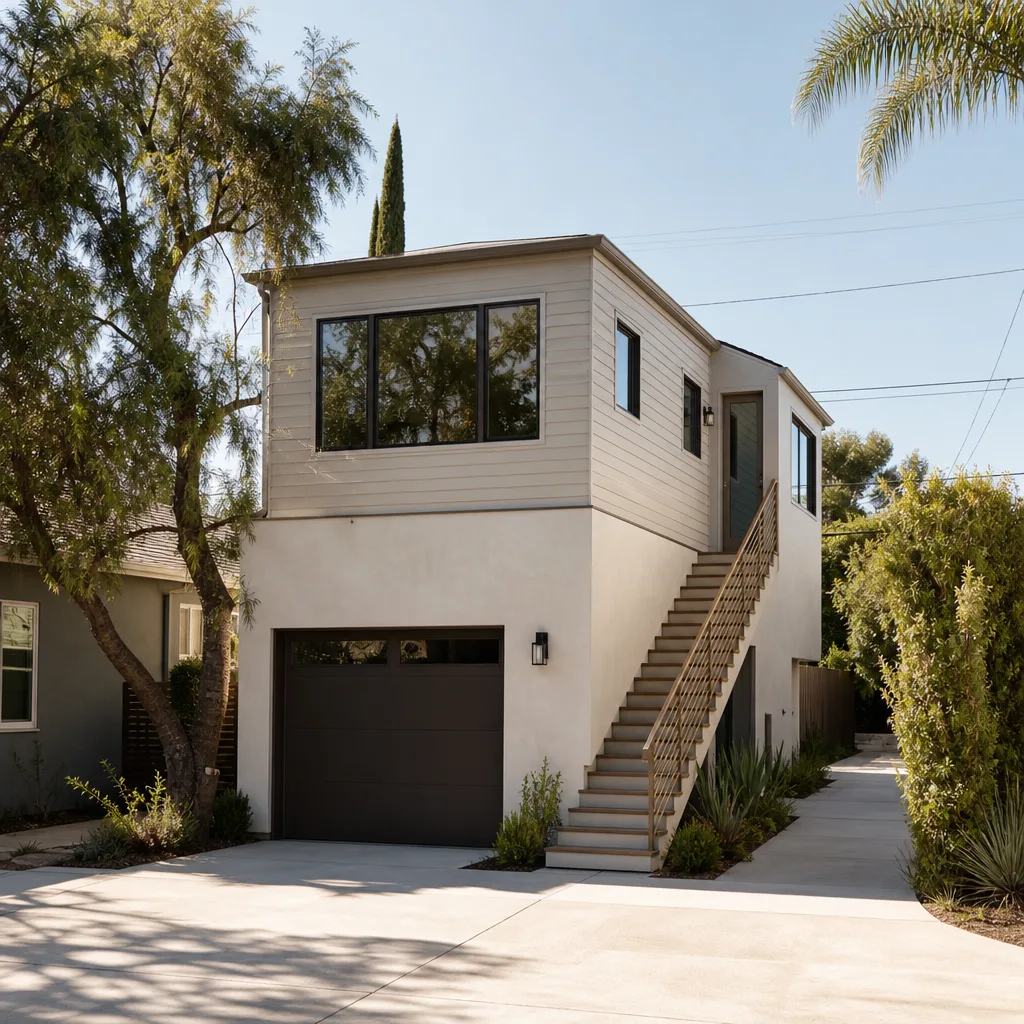
Mighty Buildings produces a limited number of panelized and 3D-printed wall and roof systems, and the junior ADU kits fall into two broad families: the earlier Mighty Mod series and the current Mighty House line. The conversion components that fail most often are the interface pieces, not the panels themselves: door and window flashing kits, corner joinery, the sill plate-to-foundation connection system, and the utility chase covers.
Here’s the compatibility gotcha most owners run into: the Mighty Mod series used a 4-inch reveal on corner trim, while the Mighty House line switched to a 3.5-inch reveal. That half-inch difference means a part that looks right on the shelf won’t seat properly, and forcing it creates the exact gap that lets moisture in. If you have the original unit documentation, the series is printed on the compliance label inside the electrical panel cover. If that’s gone, measure the corner trim reveal and we’ll match it from there.
On the OEM-versus-aftermarket question: for structural connectors and anchor hardware, we use only OEM-spec parts. For weatherstripping, door sweeps, and sealant transitions, we use equivalent or better aftermarket materials that are actually rated for Northern California’s wet-dry cycle. San Jose’s summer heat bakes most generic foam seals brittle within two seasons. We use silicone-based products that hold up better.
Signs Your Mighty Buildings Junior ADU Conversion Is Failing
- Visible daylight around the entry door or window frames. This means the original sealant bead has separated from the composite panel. Mighty Buildings panels expand and contract at a different rate than traditional framing, so the sealant eventually loses adhesion. Water follows within months if it’s not addressed.
- A dry, chalky white powder at corner joints or along the sill. This is panel surface oxidation working through an improperly sealed seam. It signals moisture intrusion at the connection point, and in San Jose’s winter rain cycle, it will progress inward.
- The door doesn’t latch without lifting the handle. The composite threshold has shifted or the hinge blocks have compressed. Because the jamb brackets on these units are integrated into the panel assembly, you can’t just shim a hinge like you would on a wood-framed door.
- Utility chase covers that rattle or no longer seat flush. The original friction clips lose tension over time, especially on sun-exposed walls. A rattling cover isn’t cosmetic; it’s the first sign the chase is no longer weather-sealed at the penetration point.
- Condensation beading on the interior panel surface near the ceiling line. That’s a roof-to-wall transition seal that’s failed. Insulation is getting wet, and in a San Jose unit that runs warm half the year, the moisture cycle accelerates seal degradation everywhere downstream of it.
Replacement Cost & What’s Included

Here’s what Mighty Buildings junior ADU conversion work actually costs in San Jose right now:
| Repair Scope | Typical Installed Range |
|---|---|
| Door or window sealant replacement (single opening) | $250 – $600 |
| Weatherstripping and threshold correction (entry door) | $350 – $750 |
| Window flashing kit replacement (one window) | $550 – $1,100 |
| Corner trim replacement and seam reseal (per corner) | $500 – $1,000 |
| Full perimeter reseal and utility chase rebuild | $1,450 – $2,800 |
| Utility chase cover and penetration reseal (multiple utility lines) | $1,100 – $2,200 |
The range depends on what we find when the old part comes off. If the panel behind the failed seal is still sound, the job stays on the low end. If moisture has gotten into the panel core, we need to open the cavity, dry it, and rebuild the connection properly, which pushes toward the high end. You get the written number before we start, and it doesn’t move unless we find something we couldn’t have seen from the outside. The Garrison Standard covers every part we install for a full year: if the repair fails inside 365 days, we come back and make it right at no charge.
DIY or Call Us?
You can diagnose the problem yourself. Look at the door and window perimeters, feel for drafts, check the corner seams for separation. That’s fifteen minutes and it tells us a lot on the phone before we even arrive. Pulling off trim and attempting a reseal is a different matter. These panels are structural composite, not wood. You can’t sand them, you shouldn’t drill into them without knowing the anchor pattern, and a too-aggressive sealant removal damages the panel surface. That’s a $200 repair turning into a $2,000 panel replacement, and we’ve seen it happen in San Jose more than once.
If you’re even half-certain the failure is more than surface-level, call us at (669) 201-3984. We’ll tell you honestly over the phone whether it’s worth a service visit, and the estimate is free.
FAQs
The original factory seals on Mighty Buildings junior ADU conversions typically last 5 to 8 years in San Jose’s climate before the first signs of separation appear. Units with full south or west sun exposure tend to fail earlier, usually at the 4- to 6-year mark. Aftermarket silicone-based reseals we install typically hold for 8 to 12 years.
Door thresholds and hinge blocks can usually be corrected without full replacement. Failing sealant beads can be removed and rebuilt if caught before moisture reaches the panel core. Once water has saturated the composite or the panel-to-panel connection is compromised, patchwork doesn’t hold and a proper replacement is the cheaper option long-term. Call (669) 201-3984 for an honest assessment, not a sales pitch.
Most single-opening seal and weatherstripping repairs are done in 2 to 3 hours on site. A full perimeter reseal with multiple openings takes one day. If we need to open a panel cavity for moisture remediation, budget two days for drying time and rebuild.
We keep the common failure items on the truck: silicone sealants rated for composite panels, weatherstripping profiles, threshold kits, and the hardware for chase cover rebuilds. For OEM-specific trim and flashing profiles, we source direct and typically have them in hand within 3 to 5 business days. We’ll tell you which bucket your job falls into before we schedule anything.
Call Fielding ADU San Jose for Mighty Buildings Conversion Work
If your Mighty Buildings junior ADU is showing signs of seal failure, door trouble, or panel-to-panel separation, don’t wait for the next rain. We’ll put the price in writing before any work starts, show up when we say we will, and stand behind the repair for a full year. That’s how we’ve operated in San Jose since we started, and it’s how we’ll handle your unit. Call (669) 201-3984 to schedule your free estimate. Reed Calloway and the crew answer the phone.
Written by Reed Calloway, Owner, Fielding ADU San Jose at Fielding ADU San Jose, serving San Jose and nearby areas.