James Hardie New Detached ADU: The San Jose Owner’s Guide
A new detached ADU clad in James Hardie siding in San Jose typically costs between $220 and $380 per square foot for the complete build, including materials, labor, permits, and the Hardie installation. If you’re here because a part of that system is failing – cracked HardiePlank, failed flashing, or a siding joint that’s opened up – we stock the common James Hardie components and can usually get the specific part matched and installed within a week, not a month. Most San Jose owners discover the problem the same way: after the first heavy winter rain, water shows up along a wall or at the baseboard, and what looked like a small gap turns out to be a siding failure that’s been developing for a season.
We are an independent ADU builder and repair contractor in San Jose, not a James Hardie company. That means when we spec a part, we match it to your existing build without a brand agenda. Our crew carries HardiePlank lap siding, HardiePanel vertical siding, HardieTrim boards, and the correct flashing and fasteners on the truck for most San Jose service calls.
Which James Hardie Models This Applies To
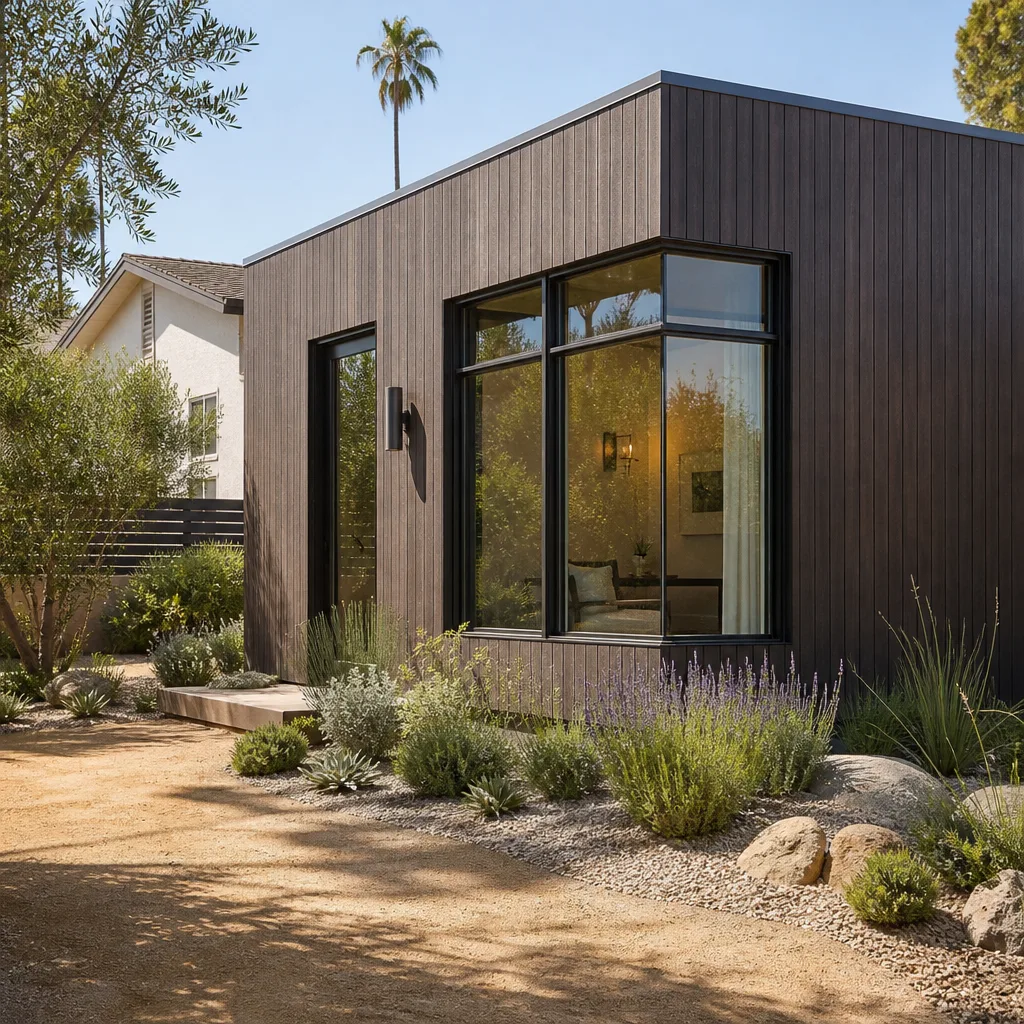
James Hardie sells several product lines, and the replacement part depends on which one your ADU was built with. The two most common on San Jose detached ADUs are HardiePlank lap siding (the horizontal boards in 5/16-inch and 7/16-inch thickness) and HardiePanel vertical siding (4×8 or 4×10 sheets). The third item you may need is HardieTrim, which comes in 4/4 and 5/4 thicknesses for corners, window surrounds, and fascia. If your ADU was built in the last eight years, you’re likely looking at ColorPlus technology, which is the factory-applied finish. Older builds used primed-only boards that were painted on site.
The compatibility gotcha with James Hardie is this: ColorPlus boards carry a 15-year finish warranty, but only if the replacement board is also ColorPlus in the exact same color code. Mix a primed board into a ColorPlus wall, and you’ll see the color mismatch from the street. You can read the color code off the back of any removed board – it’s printed there. If the board is too damaged to read, we can order a color match from the original build records or use a Hardie color chart to identify it. The second thing to check is board width. HardiePlank comes in 5.25-inch, 6.25-inch, 7.25-inch, and 8.25-inch exposures. A board that’s off by even a half-inch throws off the shadow line across the whole wall, and on a detached ADU in San Jose, you’ll see it every time you walk into the backyard.
Signs Your James Hardie New Detached ADU Is Failing
- Water staining at the bottom edge of a wall. This almost always traces up to a failed joint or a gap at a window or door flashing. The water gets behind the siding and runs down the weather barrier until it finds the sill plate. On San Jose ADUs, we see this most often on the wall facing the prevailing winter rain, which in this area comes from the south and southwest.
- A HardiePlank board that’s cracked or buckled. Fiber cement doesn’t warp like wood, but it will crack. The most common cause on detached ADUs is improper nailing at the original install, usually nails driven too deep or too close to the board edge. Once a board cracks, it’s a water pathway, not just a cosmetic problem.
- Caulk pulling away at corners and trim joints. James Hardie specifies a 1/8-inch gap at trim-to-siding intersections filled with a paintable, high-quality sealant. San Jose’s summer heat expands the boards, and when the caulk fails, the joint opens up. The fix is to rake out the old sealant, clean the joint, and reapply with a product rated for fiber cement.
- Bubbles or peeling paint on primed-only boards. If the original installer used primed HardiePlank and a lower-quality paint, San Jose’s dry summer heat and winter wet cycles will cause the paint to fail before the board does. The board underneath is often still sound, but the paint has lost its bond.
- Soft spots or discoloration behind the siding, visible from inside. By the time you see this, the water has been getting in for a while. The wall cavity is holding moisture, and the insulation or drywall is showing it. This is the point where a siding repair becomes a wall repair, which is why we’d rather catch the problem at the first sign of staining.
Replacement Cost & What’s Included
For a James Hardie siding repair on a detached ADU in San Jose, the range breaks down like this: a single-board replacement with color-matched ColorPlus runs $280 to $450 installed. A section repair covering ten to fifteen boards, including removing the damaged siding, replacing any failed flashing, and reinstalling new Hardie boards with the correct fasteners, runs $1,400 to $2,600. A full re-side of a 400-square-foot ADU exterior runs $9,000 to $16,000, depending on whether you’re using primed-only or ColorPlus and the trim complexity.
The price includes the parts, labor, disposal of the old material, and our check of the surrounding area for water damage behind the siding. We write the quote before we start, and that’s the number on the final invoice. This work is covered by the Garrison Standard: one year, in writing. If a board we installed fails inside that year, we come back and correct it at no charge. That’s not a line item; it’s our operating rule.
DIY or Call Us?
Replacing James Hardie siding is not high-tension work like a garage door spring, but it is not straightforward either. You need the right fasteners (Hardie requires specific corrosion-resistant nails or screws, and the wrong ones void the warranty), the right blade to cut fiber cement without dusting out the neighborhood, and the right flashing detail at every penetration. Most homeowners we meet in San Jose who tried a DIY Hardie repair found that the cutting produced more dust than expected and the board didn’t sit flush the way the factory boards do.
The one thing worth doing yourself is the inspection: walk the ADU with a flashlight, look at every joint and trim line, and mark anything that looks open, cracked, or stained with painter’s tape. Then call us at (669) 201-3984 and we’ll come out and tell you what actually needs replacing and what can wait. The quote is free.
FAQs
James Hardie siding carries a 30-year product warranty, but in San Jose’s climate, the realistic service life before you’ll likely need some board replacement due to weather, movement, or original install errors is 15 to 25 years. The ColorPlus finish is warrantied separately for 15 years, and we see it performing at or near that in most San Jose ADUs as long as the original flashing was done correctly.
A small chip or corner crack can sometimes be patched and repainted, but any crack that runs through the full board thickness or allows water behind the siding should be replaced, not patched. Patching a board that’s already letting water in just moves the failure further down the wall, and by the time it shows up again, the damage inside the wall is worse.
A single board swap on a San Jose ADU typically takes two to three hours on site once the matching board is in hand. If the board needs to be ordered – usually for a specific ColorPlus color code – we’ll have it within five to seven business days and schedule the install for the day it arrives. A section repair of ten or more boards is usually a one-day job.
We stock common HardiePlank lap siding in standard exposures, HardiePanel sheets, and HardieTrim boards on our service trucks, along with the correct fasteners and flashing. For ColorPlus replacements in a specific factory color code, we order the exact board from our James Hardie supply chain, which is typically a five to seven day turnaround in San Jose. Call (669) 201-3984 and tell us the color code from the back of your board, and we’ll confirm the price and lead time before we order anything.
Put it in writing, show up on time, build it right. That’s how Reed Calloway built this crew, and it’s how we handle every James Hardie repair on a San Jose detached ADU. If you’re seeing siding that’s cracked, stained, or pulling away, call us at (669) 201-3984. We’ll come out, assess it, and hand you a written quote for exactly what needs to be done – no pressure, no surprises, no slide. If the quote works for you, we’ll schedule the work and stand behind it for a full year.
Written by Reed Calloway, Owner, Fielding ADU San Jose at Fielding ADU San Jose, serving San Jose and nearby areas.