Last updated October 15, 2026
The Complete Guide to ADU in San Jose
San Jose issued over 900 ADU permits in 2023, but a meaningful share of those projects stalled at the framing stage, not because the builder lacked skill, but because someone skipped a step that should have happened months earlier. The pattern is consistent: homeowners call contractors first, get quotes, then discover the lot cannot support the ADU they designed, or the sewer lateral is in the wrong place, or the setback variance was never filed. This guide exists to fix that sequence. We are going to walk the twelve decisions in the order they actually happen, so you can approach San Jose’s Planning Division with a file that gets approved instead of returned. If you read nothing else, read the first three sections twice.
Quick Answer
Building an ADU in San Jose means working through zoning clearance, utility capacity, lot coverage math, design, and permits in that exact order, ideally before you sign with any contractor. The city allows detached, attached, and garage-conversion ADUs up to 1,000 square feet depending on your lot, and state laws like SB 9 and AB 2221 have removed most discretionary review barriers. A well-sequenced San Jose ADU project takes roughly 4 to 6 months from design to final inspection, with costs typically landing between $180,000 and $380,000 depending on build method and site conditions.
Table of Contents
- The Twelve Decisions Behind Every San Jose ADU
- Decision 1: Zoning Clearance Comes Before Anything Else
- Decision 2: Utility Capacity Is the Quiet Project Killer
- Decision 3: Lot Coverage Math Before Design Work
- Decision 4: San Jose Setback Rules for Detached, Attached, and Garage ADUs
- What SB 9 and AB 2221 Changed in San Jose
- Owner-Occupied Rules and Rental Timing in San Jose
- A Plain Checklist to Grade Any ADU Contractor Quote
- Common Mistakes to Avoid
- When to Call a Professional
- Frequently Asked Questions
- The Bottom Line
The Twelve Decisions Behind Every San Jose ADU
An ADU is not one product with a price tag. It is a chain of twelve decisions, and each one constrains the next. The sequence we see work in San Jose, from Campbell to Berryessa to Willow Glen, is this:
- Zoning check: Does your parcel legally allow an ADU, and under what rules?
- Utility capacity: Can your existing sewer lateral, water line, and electrical panel support a second dwelling?
- Lot coverage math: How much of your lot is already covered by the main house, driveway, and garage?
- Setback review: How close can the ADU sit to the property lines, and which type of ADU fits?
- Build method selection: Conventional stick-built, panelized, or prefab/modular from a company like Abodu or Cover?
- Design and floor plan: One bedroom or two, kitchen layout, storage, entry orientation.
- Permit submission: Complete plan set with structural, electrical, plumbing, and Title 24 energy calculations.
- Plan check corrections: Responding to San Jose Building Division comments without losing weeks.
- Permit issuance: The moment the job card is real and work can legally begin.
- Construction: Site prep, foundation, framing, rough-in, insulation, drywall, finishes.
- Inspections: Foundation, shear wall, rough electrical, rough plumbing, insulation, final.
- Closeout and occupancy: Certificate of occupancy, utility connections, and the start of your warranty period.
Most homeowners start at decision six, design, because it is the fun part. The contractors who get called first are often happy to draw something, because drawing is cheap and quoting is free. But a floor plan that ignores decisions one through three is a floor plan that dies at the counter. In our experience building in San Jose, the projects that finish on schedule are the ones where the first three decisions were resolved before a single wall section was drawn. This is not an opinion; it is what separates a 60-day permit from an 8-month stall. Fielding ADU Builders runs every project through this sequence, which is why we hand you a written price only after the zoning and utility picture is clear.
Decision 1: Zoning Clearance Comes Before Anything Else
Every San Jose parcel carries a zoning designation: R-1, R-2, R-1-8, and so on. That designation controls what you may build, where it may sit, and how tall it can rise. Before you draw anything, pull your parcel’s zoning from the City of San Jose’s online map, or ask us to pull it for you. You are looking for four data points: minimum lot size for an ADU, maximum ADU floor area, allowed height, and any overlay district (historic, flood, hillside) that adds a layer of review.
Here is what San Jose zoning means in practice. A standard R-1 lot of 6,000 square feet in the Cambrian area can typically support a detached ADU up to 850 to 1,000 square feet, depending on the year the zoning code was last updated for that parcel. A smaller 5,000-square-foot lot in Japantown may cap out closer to 750 square feet after you account for rear- and side-yard setbacks. A 10,000-square-foot lot in Almaden Valley has more room, but may trigger additional design review if the ADU exceeds 800 square feet in a hillside overlay. These are not trivial differences. They change what you can build, which changes what you should budget, which changes whether a prefab unit from a company like Dvele even fits on the site.
San Jose does not allow ADU permits on parcels with active code enforcement liens, and it does not allow an ADU to be sold separately from the main house. The ADU is a permanent second unit on the same title. That is a zoning fact, not a financing fact, and it matters if you are thinking about a future sale. When we evaluate a site, the first thing we do is confirm the zoning and any overlays, then we tell you, in writing, what the parcel can actually hold. No design fee, no deposit. The zoning answer comes first because everything else hangs on it.
Decision 2: Utility Capacity Is the Quiet Project Killer
Skipping the utility check is the single most common reason San Jose ADU projects stall at inspection. The floor plan works, the setbacks work, the permit gets issued, and then the electrician opens the panel and finds a 100-amp service that cannot carry a second dwelling with a range, a mini-split, and a washer/dryer. Or the plumber discovers the sewer lateral runs directly under where the ADU foundation is drawn. Or the water meter is a 5/8-inch stub that will not supply two dwellings at code-required pressure.
The fix at that stage is not a line item. It is a redesign. New panel upgrade means a new electrical plan. A relocated sewer lateral means a new site plan. A new water line from the street means trenching permits and a fresh round of plan check comments. In San Jose, where many homes in the Rose Garden and Willow Glen date to the 1950s and 1960s, undersized panels and cast-iron sewer laterals are common. We have walked onto sites where the main panel was still original to the house. That panel will not support an ADU, and no amount of finish carpentry changes that.
Run the utility check before you pay for drawings. We look at three things: electrical service amperage at the main panel, sewer lateral location and material from the city’s records or a camera scope, and water service line size at the meter. If the panel is 200 amps with spare breaker slots, you are probably fine. If the sewer lateral is clay and cracked, budget for a replacement or a spot repair before the ADU ties in. These findings get folded into the written price we hand you, because a price that ignores the panel upgrade is not a price, it is a guess.
Decision 3: Lot Coverage Math Before Design Work
Lot coverage is the percentage of your parcel covered by structures: the main house footprint, the garage, any shed on a slab, and the proposed ADU. San Jose applies a lot coverage limit, often around 40 to 45 percent for single-family residential zones, and many homeowners are surprised to learn they are already near it. A 6,000-square-foot lot with a 2,200-square-foot ranch, a 400-square-foot two-car garage, and a 200-square-foot covered patio is already at 47 percent. There is no room for an ADU unless something changes: the garage converts, the patio gets removed, or a variance gets granted.
This is why the conversation about garage conversions in San Jose often starts with lot coverage, not with design. Turn the existing garage into an ADU, and you may not add a single square foot of coverage; you are repurposing what is already there. Add a detached ADU in the backyard, and you are adding coverage on top of everything that already exists. The city’s math is unforgiving, but it is also predictable. We run the coverage calculation on every site visit, because it tells us whether the project is a conversion, a detached build, or a variance conversation before any money gets spent on plans.
One specific San Jose note: covered patios and carports often appear on assessor maps but not in the homeowner’s mental math. They count. So do any unpermitted additions, which the city may require to be legalized before or during ADU permitting. We flag those early. A homeowner who thinks they have a clean lot and discovers a 15-year-old unpermitted sunroom at plan check has just added months to their timeline. The coverage math is easy to run, and it is the difference between a real project and a hypothetical one.
Decision 4: San Jose Setback Rules for Detached, Attached, and Garage ADUs
Setbacks are the distances between a structure and the property lines, and San Jose treats the three ADU types differently. A detached ADU generally requires a 4-foot rear and side setback. An attached ADU, built as an extension of the main house, follows the same setback rules as the main dwelling, which often means 5 feet on the side and 15 to 20 feet in the rear depending on your zone. A garage conversion ADU typically requires no additional setback because the structure already exists; the walls are staying where they have been for decades.
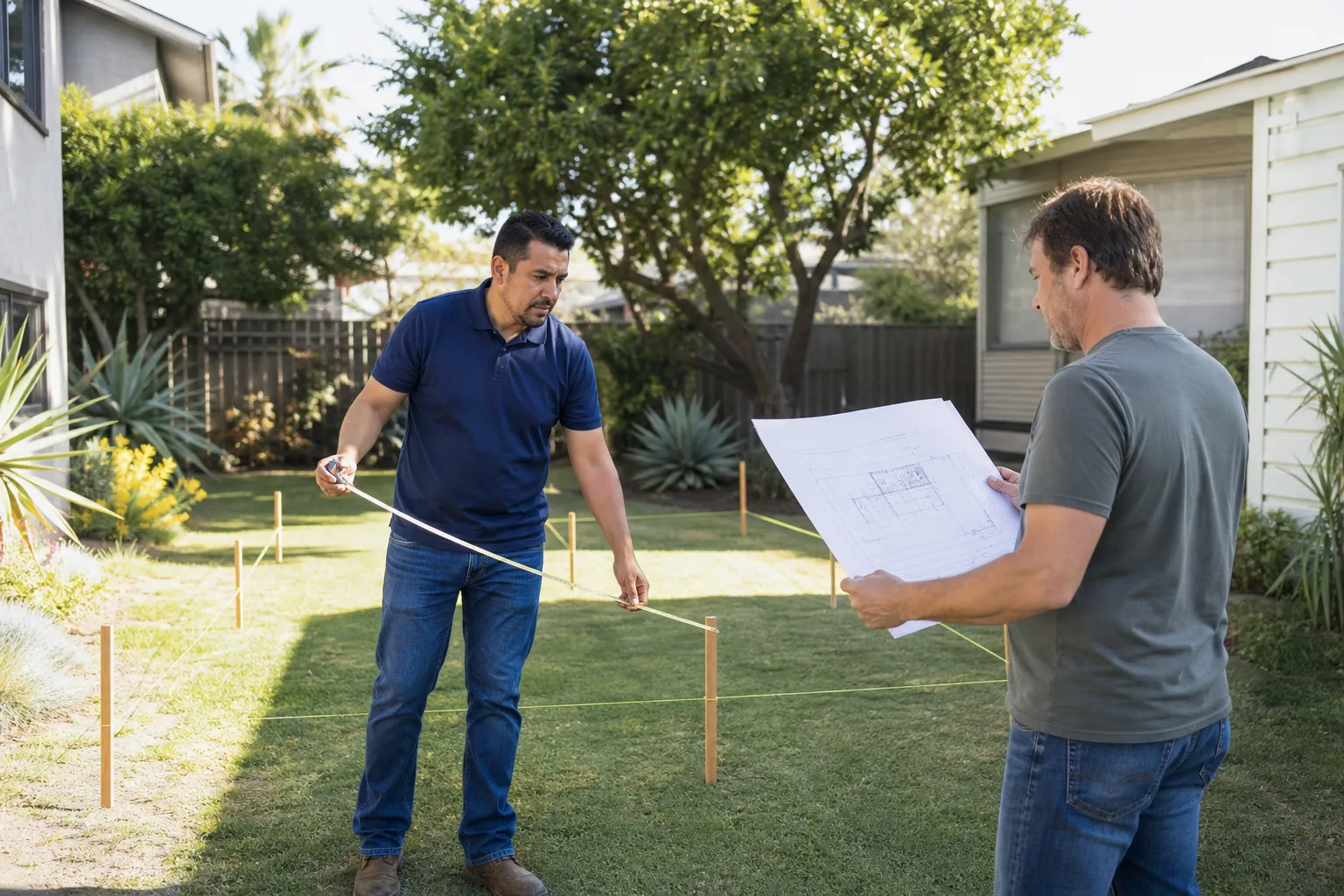
Here is a concrete lot example. On a standard 60-by-100-foot lot in the Blossom Valley area of San Jose, a detached ADU placed in the rear yard needs 4 feet from the rear line and 4 feet from each side. That means a 20-foot-wide ADU can sit comfortably in a 28-foot-wide buildable rear zone. On a 50-by-100-foot lot in the Burbank neighborhood, the same 20-foot-wide ADU gets tight: 4 feet each side leaves 42 feet of width, workable, but if the main house sits off-center, you may need to shift the ADU forward or file a setback variance. A setback variance is the city’s written permission to build closer to the property line than the standard rule allows, and San Jose will consider one if the alternative makes the ADU unfeasible.
Height matters too. Detached ADUs in San Jose can typically rise to 16 feet, or 18 feet if the parcel is within a half-mile of a transit stop, which covers a large share of the city given VTA’s light rail and bus network. Two-story ADUs are possible on larger lots, but the second story cannot exceed the first-floor footprint and must stay within the height limit. We give every client a site plan marked with the actual setbacks for their parcel, because a drawing that ignores the 4-foot line is a drawing that gets sent back. Our ADU builders in San Jose run this setback review on every estimate, no exceptions.
What SB 9 and AB 2221 Changed in San Jose
Two state laws shifted the ground under San Jose ADU permitting, and neither one is optional. SB 9, effective January 2022, allows up to two primary dwellings on a single-family parcel and a lot split in some cases, which effectively raises the number of units a homeowner can create. AB 2221, effective January 2023, closed loopholes that cities used to stall ADU approvals. The combined effect in San Jose is that the city must approve a conforming ADU application ministerially, meaning without a public hearing or discretionary design review, as long as it meets the objective standards in the code.
What San Jose still controls: setbacks, height limits, lot coverage, fire safety access, and the requirement that the ADU be on the same parcel as a single-family home or an existing multi-family building. What the state removed: minimum lot size requirements for ADUs, owner-occupancy requirements for ADUs permitted between 2020 and 2025, and impact fees for ADUs under 750 square feet. A 600-square-foot detached ADU in San Jose now pays no school impact fees, no park fees, and no traffic fees, which can save $15,000 to $30,000 compared to a few years ago. That is real money, and it changes the math on whether an ADU pencils out.
There is still local control in the details. San Jose requires a building permit, of course, plus separate electrical, plumbing, and mechanical permits. Hillside parcels in the East Foothills may trigger a geotechnical review that flatland parcels avoid. Flood zone parcels near Coyote Creek or Guadalupe River may need elevation certificates. The state mandates approval for conforming projects, but the city still gets to define what conforming means. That is why the zoning check in decision one matters more than ever: the path to a ministerially approved permit starts with knowing exactly which standards your parcel must meet.
Owner-Occupied Rules and Rental Timing in San Jose
The owner-occupied question in San Jose is a timing question more than a permanent restriction. For ADUs permitted between January 1, 2020 and January 1, 2025, the state suspended any owner-occupancy requirement. For ADUs permitted after January 1, 2025, cities may impose an owner-occupancy requirement, but San Jose has stated it will not apply one to ADUs. That means a homeowner in San Jose who builds an ADU today can rent both the main house and the ADU from the day the certificate of occupancy is issued, without living on the parcel.
The practical effect is that a San Jose ADU can be a pure rental asset. A one-bedroom ADU in the Berryessa or West San Jose rental market typically rents for $1,800 to $2,400 per month, depending on condition and location. A two-bedroom ADU can push past $2,800 in strong school districts. Against a build cost of $200,000 to $300,000, the rent often covers the construction loan payment before the first term is up. That is the calculation driving the current wave of San Jose ADU construction, and it is a sound one if the build cost is real on day one, not a moving target.
One caution: short-term rentals remain subject to San Jose’s business tax and occupancy rules, and renting an ADU as an Airbnb for under 30 days triggers a different regulatory path than a standard 12-month lease. The city treats long-term residential rental of an ADU as a permitted use, which is the arrangement most homeowners choose. If you want to occupy the ADU yourself and rent the main house, that is also allowed, and we have built several San Jose ADUs for exactly that purpose. Fielding ADU San Jose home is the starting point for a free site evaluation on your parcel.
A Plain Checklist to Grade Any ADU Contractor Quote
Most ADU quotes in San Jose are not quotes. They are estimates with allowances, exclusions, and a set of assumptions buried on page three. Here is the checklist we recommend using before you sign anything-see our How to Hire a ADU Contractor in San Jose: A Step-by-Step Guide for deeper guidance on vetting contractors. Run each item against the written document you received, and if the contractor cannot answer, ask for the answer in writing.
- Is the price a fixed number or an allowance? Allowances are open doors. A quote that says “electrical: $12,000 allowance” can become $18,000 at rough-in. Get a fixed line-item price.
- Does the scope include permits, plans, and inspections? Some quotes cover construction only and expect you to handle the city. That is a warning sign.
- Are utility upgrades listed as line items? Panel upgrade, sewer lateral repair, water line replacement: if these are absent, they will appear as change orders.
- Is site prep included? Tree removal, stump grinding, grading, and demolition debris have real costs. They should be in the price.
- Who pulls the permit and who is listed as the contractor of record? If the answer is anyone other than a licensed contractor with a current license, walk.
- What is the warranty, and is it in writing? A one-year written guarantee is the floor. Fielding ADU Builders writes ours into every contract: if the work fails within 365 days, we return and correct it at no charge.
- What is the schedule, and what are the penalties for missing it? A schedule without consequences is a suggestion, not a commitment.
We hand every San Jose client a written price before any work starts. The number you approve on day one is the number on the final invoice. That is the Garrison Standard, and it applies to every room addition in San Jose and every garage conversion we build. If a contractor will not put the price in writing, the price is not real.
Common Mistakes to Avoid
- Drawing floor plans before checking zoning and utilities. You are designing for a lot you have not verified. The design will change, and the design fee is wasted.
- Assuming the garage conversion needs no permits. It does. San Jose requires a full permit for any garage converted to habitable space, and unpermitted work already in place will come up at plan check.
- Ignoring the sewer lateral location. In older San Jose neighborhoods, laterals run diagonally through the yard. We have seen them pass directly under a proposed ADU footprint. Finding that after permit issuance is expensive.
- Budgeting for construction but not for plan check and school fees. San Jose’s plan check fees and remaining impact fees for larger ADUs can add $8,000 to $20,000. Put them in the budget.
- Choosing a contractor based on price per square foot alone. A low per-square-foot number with open allowances is not cheaper. It is unmeasured. Compare fixed written prices.
- Signing a contract without a written warranty. Every contractor says they stand behind their work. Get the guarantee on paper, with a term, a scope, and a remedy. Ours is 365 days, in writing, no charge for the return visit.
- Forgetting that prefab ADU platforms have their own site requirements. A unit from Abodu or Cover still needs a foundation, utility connections, and permits. The prefab price is not the project price.
When to Call a Professional
Call a professional when the zoning and utility picture is still unclear, before you have paid for design work. Call when you have received a quote with allowances instead of fixed numbers and need a second written price to compare. Call when your garage conversion is stalled at plan check and the contractor has gone quiet. Call when you inherited an unpermitted structure and want to know whether it can be folded into an ADU permit. San Jose ADU permitting is not a hobby; it is a regulatory process with real deadlines and real consequences for missing them. Fielding ADU San Jose offers free estimates in San Jose, we pull the permit for you, and we put the price in writing before any work starts. Call (669) 201-3984 to schedule yours. A live person answers, day or night.
Frequently Asked Questions
A detached ADU in San Jose typically costs between $220,000 and $380,000 including design, permits, utilities, and construction, while a garage conversion typically runs $120,000 to $200,000 before optional finishes. Prefab and modular units from companies like Abodu or Cover often start around $180,000 for the structure alone, with site work, foundation, and utility connections adding $60,000 to $120,000. These are San Jose-market numbers, not national averages. Call (669) 201-3984 for an exact written quote on your parcel, the estimate is free.
Plan for 4 to 8 months from design start to certificate of occupancy, with permit review typically taking 6 to 12 weeks and construction 3 to 5 months. Prefab projects can shorten construction to 8 to 12 weeks after the foundation is ready, but the permit timeline is the same. Delays usually come from incomplete plan sets or unresolved utility issues, not from the city’s processing speed alone.
No. Under current San Jose policy and state law, no owner-occupancy requirement applies to ADUs, which means you can rent both the main house and the ADU from the day the certificate of occupancy is issued. Long-term rentals are a permitted use. Short-term rentals under 30 days follow separate city rules.
Yes, and garage conversions are often the fastest and least expensive path to an ADU in San Jose because the structure already exists and lot coverage does not increase. You will need a full permit, which includes insulation upgrades, a new foundation check, window and door installation, and the replacement of the garage door with a permanent wall. Expect the city to require that any unpermitted work on the garage be legalized as part of the permit.
San Jose allows a detached ADU up to 1,000 square feet, or up to 850 square feet for a one-bedroom and 1,000 for a two-bedroom in most single-family zones, subject to lot coverage and setback limits. Attached ADUs may be up to 50 percent of the main home’s living area, capped at 1,000 square feet. A garage conversion is limited to the footprint of the existing garage.
Yes. Fielding ADU Builders is fluent with leading prefab and modular ADU platforms including Abodu, Cover, Dvele, and others, and we also build conventional ADUs with materials like James Hardie siding. That means we can recommend the right build method for your budget and lot rather than steering you toward one system. Reed Calloway and the team will show you the cost difference in writing before you commit.
The Bottom Line
An ADU in San Jose is a sequence of twelve decisions, and the first three, zoning, utilities, and lot coverage, determine everything that follows. Run them before design. Know your setbacks, know what SB 9 and AB 2221 require the city to approve, and know that no owner-occupancy rule bars you from renting the unit. Then get a written price from a contractor who will stand behind the work for a full year. Fielding ADU San Jose has been building to that standard since 2006, with written pricing before work starts and a 365-day written guarantee on every project. Call (669) 201-3984 and we will walk your lot, check your zoning, and hand you a number in writing.
Written by Reed Calloway, Owner at Fielding ADU San Jose, serving San Jose since 2006.